
Mountain road trips from Chandigarh can take you through very different weather conditions within a single journey. You may leave Chandigarh in bright sunshine and later encounter cooler temperatures, clouds, rain, fog or wet roads as you gain elevation.
For a self-drive trip, preparing for these changes is just as important as choosing the destination. A little planning before departure can make it easier to adapt when the weather changes during the journey.
Before selecting your vehicle, it is also useful to understand how different cars perform for different routes. The complete guide to renting a self-drive car in Chandigarh covers important factors to consider when choosing a rental vehicle.
Why Mountain Weather Can Change Quickly
Mountain weather can be less predictable than weather in flatter areas. Changes in elevation, cloud cover, wind and local conditions can cause noticeable differences during the same journey.
A route may include:
- Warm weather at lower elevations
- Cooler temperatures higher up
- Sudden cloud cover
- Rain showers
- Fog
- Wet or slippery roads
- Strong winds
- Reduced visibility
This is why checking the weather only before leaving Chandigarh is not always enough.
Check the Weather Before Starting

One of the simplest mountain road trip weather tips is to check the forecast before departure.
Look at:
- Weather along the complete route
- Rain probability
- Visibility conditions
- Temperature changes
- Wind conditions
- Any road or travel advisories
- Expected weather at your destination
If your trip involves several stops, check the conditions for each major location rather than only checking the final destination.
For additional road-trip planning, you can also explore the Gagan Self Drive Cars blog section for travel and self-drive guides.
Plan Your Driving Around Daylight
Mountain roads can become more challenging when visibility decreases.
Whenever practical, plan the more difficult sections of your journey during daylight hours.
This is especially useful when your route includes:
- Sharp bends
- Narrow roads
- Steep climbs
- Forest sections
- Areas with frequent fog
- Roads unfamiliar to you
A longer daylight window can give you more time to deal with unexpected stops or weather changes without rushing.
Check Your Rental Car Before Leaving
Weather preparation isn’t only about clothing and umbrellas. The vehicle should also be ready.
Before starting your trip, check:
Tyres
Look at the overall tyre condition and make sure there is no obvious damage.
Brakes
Pay attention to any unusual noise or braking behaviour.
Wipers
Good visibility becomes especially important during rain.
Lights
Check headlights, brake lights and indicators.
Windscreen
Keep the windscreen clean so that rain, fog and glare don’t reduce visibility unnecessarily.
If you notice an issue before starting your journey, it is better to address it before reaching the mountains. Our guide on what to do if you notice a problem with your rental car can also be useful when preparing for a self-drive journey.
Keep the Windscreen Clear
Rain and fog can quickly reduce visibility.
Before driving through changing weather, make sure:
- The windscreen is clean
- Wipers work properly
- Washer fluid is available
- Mirrors are clean
- Windows are clear of unnecessary condensation
Avoid driving with poor visibility simply because you are trying to maintain your planned arrival time.
Reduce Speed When Visibility Drops
One of the most important changing weather driving habits is adjusting your speed according to visibility.
If fog, heavy rain or mist makes it harder to see the road ahead, reduce speed and increase the distance from the vehicle in front.
Your speed should allow you enough time to react to:
- Vehicles
- Pedestrians
- Animals
- Fallen branches
- Road debris
- Sudden bends
- Stopped traffic
Don’t let the speed limit become your target speed when conditions require slower driving.
Be Careful on Wet Mountain Roads
Rain can change the way the road feels under the tyres.
Wet roads may provide less grip, while water flowing across the road can create additional hazards.
During rainfall:
- Avoid sudden acceleration
- Brake smoothly
- Increase following distance
- Reduce speed before bends
- Avoid aggressive steering
- Watch for water flowing across the road
This becomes especially important on winding sections.
For more information about handling sharp mountain turns, our guide to driving on hairpin bends can be included in your pre-trip reading.
Prepare for Temperature Changes
You may experience a noticeable temperature difference between Chandigarh and your destination.
Instead of carrying one heavy jacket, consider dressing in layers.
A practical combination can include:
- Comfortable base layer
- Light sweater or fleece
- Windproof or rain-resistant outer layer
- Comfortable trousers
- Closed shoes
- Extra socks
This makes it easier to adapt as temperatures change throughout the day.
Carry Rain Protection
Even when the forecast looks mostly clear, carrying basic rain protection is useful for a mountain trip.
Consider packing:
- Compact umbrella
- Lightweight rain jacket
- Waterproof bag covers
- Extra socks
- Small towel
- Waterproof phone pouch
These items take little space but can be useful if conditions change unexpectedly.
Keep Your Phone and Power Bank Charged
Weather changes can sometimes mean longer travel times.
Your phone may be needed for:
- Navigation
- Weather updates
- Calling your rental provider
- Emergency communication
- Checking alternate routes
Keep your phone charged and consider carrying a power bank.
Don’t rely entirely on mobile navigation either. Save important route information beforehand in case connectivity becomes unreliable.
Carry Some Basic Emergency Essentials
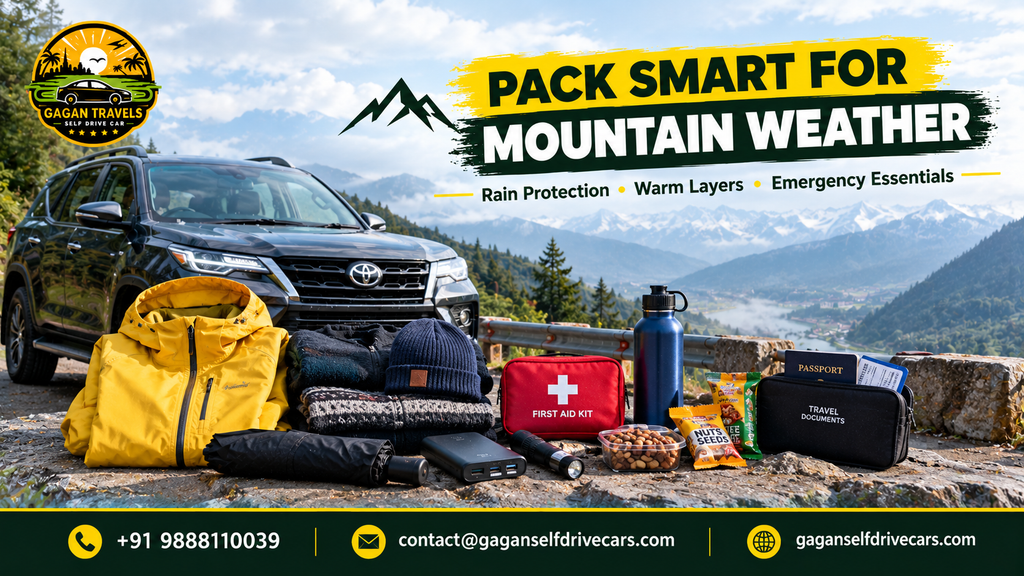
A mountain road trip does not require carrying your entire house, but a few practical items can be useful.
Consider keeping:
- First-aid kit
- Torch
- Power bank
- Drinking water
- Snacks
- Basic medicines you normally use
- Rain protection
- Extra charging cable
- Important documents
Keep frequently needed items accessible rather than buried under luggage.
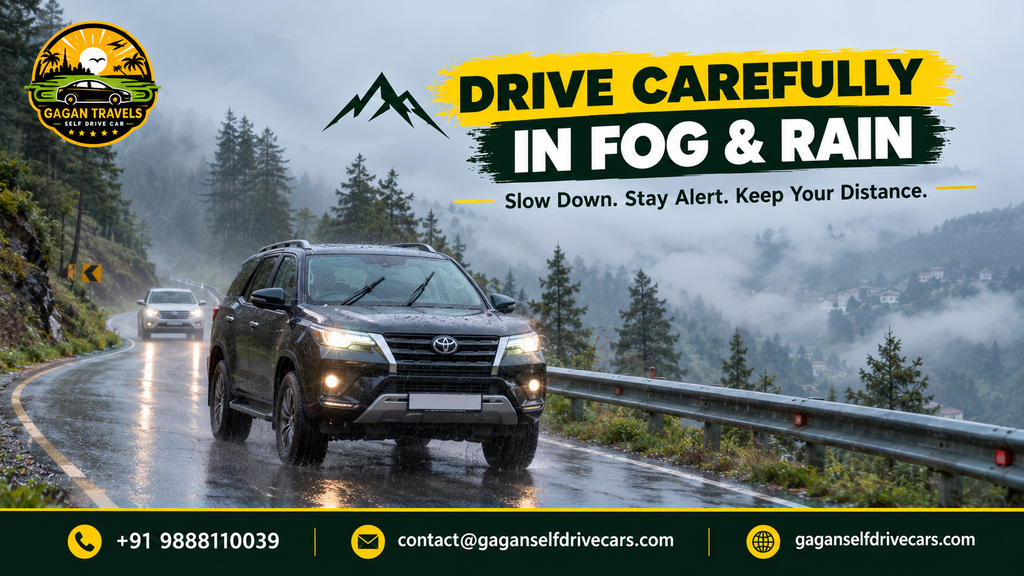
Don’t Ignore Fog.
Fog can appear suddenly on mountain roads, particularly around higher elevations and forested sections.
When visibility becomes poor:
- Reduce speed.
- Increase following distance.
- Use the vehicle’s appropriate lights.
- Avoid sudden lane changes.
- Stay alert for stopped vehicles.
- Avoid overtaking when visibility is restricted.
If you cannot clearly see the road ahead, slowing down is more useful than trying to maintain your previous speed.
Watch for Road Debris
Changing weather can sometimes result in branches, stones, mud or other debris appearing on the road.
Keep your attention beyond just the vehicle directly ahead.
On mountain roads, scan the road surface regularly and be prepared to slow down when approaching an unfamiliar section.
Avoid Following the Schedule Too Rigidly
A common mistake during road trips is treating the itinerary as more important than the conditions.
Suppose your plan says you should reach the next destination by a particular time, but rain or fog becomes heavier.
Don’t feel pressured to maintain the original pace.
It may be better to:
- Take a short break
- Wait for visibility to improve
- Reduce your driving speed
- Stop at a safe location
- Adjust your itinerary
A flexible itinerary is particularly useful for mountain travel.
Choose a Car According to the Route
The vehicle you select should match the road conditions and your travel requirements.
For a primarily paved route with a small group, a compact vehicle may be suitable depending on the journey.
For longer trips with several passengers and luggage, an SUV may provide additional cabin and luggage space.
You can explore SUV rental options in Chandigarh when planning a larger mountain trip.
For routes where four-wheel drive is relevant, you can also check the available 4×4 rental options in Chandigarh.
The important point is to select a vehicle based on the actual route rather than assuming that one type of vehicle is suitable for every mountain journey.
What to Do If Weather Becomes Severe
If conditions suddenly become difficult, don’t try to prove that you can continue.
Depending on the situation, consider:
- Reducing speed significantly
- Finding a safe stopping location
- Waiting for visibility to improve
- Checking the route again
- Contacting your rental provider if necessary
- Adjusting the day’s destination
Never stop in the middle of a blind bend or narrow section simply because you want to check your phone.
Find a safe location first.
Common Mistakes During Changing Mountain Weather
Ignoring Weather Updates
Checking the weather only once before leaving isn’t always enough.
Driving at the Same Speed
Conditions can change, so your speed should change accordingly.
Starting a Difficult Mountain Section Too Late
Avoid unnecessarily entering unfamiliar mountain roads after daylight hours.
Overloading the Car
Carry what you need, but avoid unnecessary luggage that takes up space and adds weight.
Ignoring Small Vehicle Issues
A minor wiper, tyre or light problem can become more inconvenient during bad weather.
Depending Completely on Mobile Internet
Prepare important route information in advance.
Rushing Because of an Itinerary
Weather conditions should influence the plan.
Final Mountain Driving Preparation
A successful self-drive mountain trip is not just about reaching the destination. It is also about being prepared for what can happen along the route.
Before leaving Chandigarh, check the weather, inspect your vehicle, carry suitable clothing and keep your itinerary flexible. Once you’re on the road, adjust your speed and driving style according to visibility, road surface and traffic.
For drivers planning longer journeys, our self-drive car rental guides provide additional information about vehicle selection, road trips and rental preparation.
FAQs
Check the weather forecast, route, vehicle condition, tyres, brakes, lights, wipers, fuel and required documents before departure.
Carry layered clothing, rain protection, extra socks, water, snacks, a power bank and basic emergency essentials.
Yes. Reduced visibility and wet roads can require lower speeds and greater following distance.
No. The appropriate vehicle depends on the specific route, road conditions, passengers, luggage and your driving requirements.
Reduce speed, avoid risky sections and look for a safe place to stop. If necessary, adjust your itinerary rather than continuing under uncomfortable conditions.
Conclusion

Mountain weather can change quickly, so preparation should be part of every self-drive trip from Chandigarh.
Check the forecast, inspect your rental car, carry suitable clothing and rain protection, keep your phone charged and be prepared to adjust your driving according to the conditions.
Most importantly, don’t let your planned arrival time dictate your driving speed. A flexible itinerary gives you more room to respond safely when mountain weather changes.


